Tuesday, April 29, 2014

Think out of the Box

A father left 17 Camels as an Asset for his Three Sons.
When the Father passed away, his sons opened upthe will.
The Will of the Father stated that the Eldest son should get Half of 17 Camels,
The Middle Son should be given 1/3rd of 17 Camels,
Youngest Son should be given 1/9th of the 17 Camels,
As it is not possible to divide 17 into half or 17 by 3 or 17 by 9, the sons started to fight with each other.
So, they decided to go to a wise man.

The wise man listened patiently about the Will.
The wise man, after giving this thought, brought one camel of his own & added the same to 17.
That increased the total to 18 camels.

Now, he started reading the deceased father’s will.
Half of 18 = 9.
So he gave 9 camels
to the eldest son.
1/3rd of 18 = 6.
So he gave 6 camels
to the middle son.
1/9th of 18 = 2.
So he gave 2 camels
to the youngest son.
Now add this up:
9 + 6 + 2 = 17 &
This leaves 1 camel, which the wise man took back.

MORAL: The attitude of negotiation & problem solving is to find the 18th camel i.e. the common ground. Once a person is able to find the common ground, the issue is resolved. It is difficult at times.
However, to reach a solution, the first step is to believe that there is a solution. If we think that there is no solution, we won’t be able to reach any!
Think out of the Box

Thursday, December 12, 2013

Did You Know ?

1. Your  are the first thing people subconsciously notice about you. Wear nice shoes.

2. If you sit for more than 11 hours a day, there's a 50% chance you'll die within the next 3 years

3. There are at least 6 people in the world who look exactly like you. There's a 9% chance that you'll meet one of them in your lifetime.

4. Sleeping without a pillow reduces back pain and keeps your spine stronger.

 5. A person’s height is determined by their father, and their weight is determined by their mother.

6. If a part of your body "falls asleep",
you can almost always "wake it up" by shaking your head.

7. There are three things the human brain cannot resist noticing - Food, attractive people and danger

8. Right-handed people tend to chew food on their right side

9. Putting dry tea bags in gym bags or smelly shoes will absorb the unpleasant odour.

10. According to Albert Einstein, if honey bees were to disappear from earth, humans would be dead within 4 years.

11. There are so many kind of apples, that if you ate a new one everyday, it would take over 20 years to try them all.

12. You can survive without eating for weeks, but you will only live 11 days without sleeping.

13. People who laugh a lot are healthier than those who don’t.

14. Laziness and inactivity kills just as many people as smoking.

15. A human brain has a capacity to store 5 times as much information as Wikipedia

16. Our brain uses same amount power as 10-watt light bulb!!

17. Our body gives enough heat in 30 mins to boil 1.5 litres of water!!

18. The Ovum egg is the largest cell and the sperm is the smallest cell !!

19. Stomach acid (conc. HCl) is strong enough to dissolve razor blades!!

20. Take a 10-30 minute walk every day. & while you walk, SMILE. It is the ultimate antidepressant.

21. Sit in silence for at least 10 minutes each day.

22. When you wake up in the morning, Pray to ask God's guidance for your purpose, today.

23. Eat more foods that grow on trees and plants and eat less food that is manufactured in plants.

24. Drink green tea and plenty of water. Eat blueberries, broccoli, and almonds.

25. Try to make at least three people smile each day.

26. Don't waste your precious energy on gossip, energy vampires, issues of the past, negative thoughts or things you cannot control. Instead invest your energy in the positive present moment.

27. Eat breakfast like a king, lunch like a prince and dinner like a college kid with a maxed out charge card.

28. Life isn't fair, but it's still good.

29. Life is too short to waste time hating anyone. Forgive them for everything !

30. Don't take yourself so seriously. No one else does.

31. You don't have to win every argument. Agree to disagree.

32. Make peace with your past so it won't spoil the present.

33. Don't compare your life to others. You have no idea what their journey is all about.

34. No one is in charge of your happiness except you.

35. Frame every so-called disaster with these words: 'In five years, will this matter?'

36. Help the needy,Be generous ! Be a 'Giver' not a 'Taker'

37. What other people think of you is none of your business.

38. Time heals everything.

39. However good or bad a situation is, it will change.

40. Your job won't take care of you when you are sick. Your friends will. Stay in touch.

41. Envy is a waste of time. You already have all you need.

42. Each night before you go to bed ,Pray to God and Be thankful for what you'll accomplish, today !

43. Remember that you are too blessed to be stressed.

Monday, December 9, 2013

It travels over land and water

It travels over land and water.
Who invented the HOVERCRAFT ?

A. S. Sperrow

B. O. Stricheg

C. T. Henman

D. C. Cockerell

Ans-D

Wednesday, July 10, 2013

Tortoise

Turtles have been on the earth for more than 200 million years. They evolved before mammals, birds, crocodiles, snakes, and even lizards.
The earliest turtles had teeth and could not retract their heads, but other than this, modern turtles are very similar to their original ancestors.
Turtles live on every continent except Antarctica.
Turtles will live in almost any climate warm enough to allow them to complete their breeding cycle.
While most turtles do not tolerate the cold well, the Blanding’s turtle has been observed swimming under the ice in the Great Lakes region.
Turtles range in size from the 4-inch Bog Turtle to the 1500-pound Leathery Turtle.
North America contains a large variety of turtle species, but Europe contains only two species of turtle and three species of tortoise.
The shell of a turtle is made up of 60 different bones all connected together.
Most land tortoises have high, domed carapaces that offer protection from the snapping jaws of terrestrial predators.
Most turtle species have five toes on each limb with a few exceptions including the American Box Turtle of the Carolina species that only has four toes and, in some cases, only three.
Turtles have good eyesight and an excellent sense of smell. Hearing and sense of touch are both good and even the shell contains nerve endings.
Some aquatic turtles can absorb oxygen through the skin on their neck and cloacal areas allowing them to remain submerged underwater for extended periods of time and enabling them to hibernate underwater.
Turtles are one of the oldest and most primitive groups of reptiles and have outlived many other species. One can only wonder if their unique shell is responsible for their longevity.
You might also like:

Tuesday, July 9, 2013

Kilimanjaro

Elevation: 19,340 feet
Location: Tanzania, east Africa
The meaning and origin of the name Kilimanjaro is unknown. It is thought to be a combination of the Swahili word Kilima, meaning “mountain,” and the KiChagga word Njaro, loosely translated as “whiteness,” giving the name White Mountain.
Kilimanjaro, the highest mountain in Africa and fourth highest of the Seven Summits, is considered the tallest freestanding mountain in the world, rising 15,100 feet (4,600 meters) from base to summit.
Kilimanjaro is composed of three distinct volcanic cones: Kibo 19,340 feet (5,895 meters); Mawenzi 16,896 feet (5,149 meters); and Shira 13,000 feet (3,962 meters). Uhuru Peak is the highest summit on Kibo’s crater rim.
Kilimanjaro is a giant stratovolcano that began forming a million years ago when lava spilled from the Rift Valley zone. The mountain was built by successive lava flows. Two of its three peaks—Mawenzi and Shira—are extinct while Kibo, the highest peak is dormant and could erupt again.
Kilimanjaro has 2.2 square kilometers of glacial ice and is losing it quickly due to global warming. The glaciers have shrunk 82% since 1912 and declined 33% since 1989.
Kilimanjaro lies within the 756-square-kilometer Kilimanjaro National Park, a UNESCO World Heritage Site, and is one of the few places on earth that encompasses every ecological life zone including tropical jungle, savannah, and desert to montane forests, subalpine plants, and the alpine zone above timberline.
Kilimanjaro has five common routes to its highest summit: Marangu Route; Machame Route; Rongai Route; Lemosho Route; and Mweka Route.
Climbing Kilimanjaro is easy and requires no technical climbing or mountaineering experience. The biggest challenge and danger is the high altitude. Climbers die from improper acclimatization and altitude sickness rather than falls.
Kilimanjaro is not a peak you can climb on your own. It is mandatory to climb with a licensed guide and have porters carry your equipment. This sustains the local economy and allows local people to reap the rewards of tourism.
The fastest verified ascent time was by Italian Bruno Brunod in 2001. He climbed Uhuru Peak from Marangu Gate in 5 hours, 38 minutes, and 40 seconds. The fastest round-trip time was by local guide Simon Mtuy who ran up and down on December 26, 2004 in 8 hours and 27 minutes.
Mount Meru, a 14,980-foot volcanic cone, lies 45 miles west of Kilimanjaro. It is an active volcano; has a snowcap; lies in Arusha National Park; and is often climbed as a training peak for Kilimanjaro.

Monday, July 8, 2013

Valcanoes

A volcano is a mountain that opens downward to a pool of molten rock below the surface of the earth. When pressure builds up, eruptions occur.
In an eruption, gases and rock shoot up through the opening and spill over or fill the air with lava fragments. Eruptions can cause lava flows, hot ash flows, mudslides, avalanches, falling ash and floods.
The danger area around a volcano covers about a 20-mile radius.
Fresh volcanic ash, made of pulverized rock, can be harsh, acidic, gritty, glassy and smelly. The ash can cause damage to the lungs of older people, babies and people with respiratory problems.
Volcano eruptions have been known to knock down entire forests.
An erupting volcano can trigger tsunamis, flash floods, earthquakes, mudflows and rockfalls.
More than 80% of the earth’s surface is volcanic in origin. The sea floor and some mountains were formed by countless volcanic eruptions. Gaseous emissions from volcano formed the earth’s atmosphere.
There are more than 500 active volcanoes in the world. More than half of these volcanoes are part of the “Ring of Fire,” a region that encircles the Pacific Ocean.
Active volcanoes in the U.S. are found mainly in Hawaii, Alaska, California, Oregon and Washington, but the greatest chance of eruptions near areas where many people live is in Hawaii and Alaska.
Even though the volcanic eruption in Iceland was relatively small, the ash cloud that was produced disrupted European air travel for six days in April 2010. The eruption created the highest level of air travel disruption World War II.
Crater Lake in Oregon formed from a high volcano that lost its top after a series of tremendous explosions about 6,600 years ago.

Sunday, July 7, 2013

DOGS

Dogs have been domesticated for 10,000 years.
There are over 200 different breeds of dogs
Canis Familiaris is the Latin name for dog.
The largest dogs among all breeds, at least in terms of height, is the Irish Wolfhound.
Nearly all but two breeds of dogs have pink tongues. The two exceptions? The Chow Chow and the Shar-pei, both with black tongues.
The Basenji is the only barkless dog in the world.
Dalmatian puppies are born pure white, with their spots developing as the mature.
The ancient Chinese royalty loved the Pekingese, carrying them tucked into the sleeves of their royal robes.
Greyhounds are no doubt fast. In fact, they can reach speeds of up to 45 miles per hour for short amounts of time.
Many dogs’ eyes reflect the color green in the dark, but some also reflect orange or red.
Laikia, a dog, was the world’s first ever space astronaut. She was sent into space in an artificial earth satellite in 1957 by the Russian government.
Survivors of the Titanic included two dogs: a Pekingese belonging to Henry Sleeper Harper and a Pomeranian belonging to Miss Margaret Hays.
The oldest known breed of dog is the Saluki, which is an Arabic word meaning noble one. These dogs were raised as hunting dogs by ancient Egyptians.
The oldest breed of dog native to North America is the Chihuahua.
Every minute, dogs take ten to thirty breaths.
The only mammals with prostates are humans and dogs.
There are 42 teeth in a dog’s mouth.
One of the very first animals domesticated by humans was the dog.
The oldest known dog lived to be 29.
The “spring” in Springer Spaniel referred to this dog’s ability to spring or startle game.
In Flemish, Schipperke translates to “Little Captain.”
The Lhasa Apso was used by monks to guard temples.

Friday, July 5, 2013

Singapore Flyer


20120301-080101.jpg

Diameter: Singapore Flyer is 150 metres in diameter – about the length of 87 Singaporean men lying down head-to-toe. The average Singaporean man is 1.72m tall.
Height: Singapore Flyer measures 165 metres in height – about the height of a 42-storey building. To amuse your child, describe the height as “31 male giraffes stacked on top of one another”. The average height of a giraffe is 5.3 metres.
Land area: Singapore Flyer stands on 33,700m2 or 363,000 ft2 – an area that will fit 172 tennis courts or 1,120 parking lots. A typical parking lot is 30m2.
Capsule size: Each capsule is 4 metres x 7 metres – about the size of a city bus. There are 28 capsules. Each capsule can carry up to 28 passengers.
Speed it travels: 0.24m per second, or 0.76km/h.
Total capacity per revolution: 784 passengers.
Boarding & Flying
Boarding: To board the capsule, you use the “step on platform” – it’s like walking on level ground into the capsule. There are two synchronised doors and two platforms on each side – making it easy for the elderly and those in wheelchairs to get on and off.
Rotation: Each rotation is about 32 minutes.
Smooth Rotation: Singapore Flyer is designed and built to rotate smoothly under various wind conditions at high altitudes – thanks to precision wind engineering.
View Radius: On board Singapore Flyer, you can see up to 45 kilometres away – that’s 3 kilometres more than the entire length of our island city. From the Flyer, you’ll be able to see Changi Airport, Sentosa Island, and even parts of Malaysia and Indonesia.
Design & Technology
Design: Singapore Flyer is the brainchild of world renowned architect Dr. Kisho Kurokawa (Japan) and architectural firm DP Architects (Singapore). The design is notably “avant-garde” – experimental and innovative while emphasizing simplicity and harmony.
Technological Wonder: Singapore Flyer uses a slim ladder truss rim – not the usual triangular rim used by other observation wheels.

Thursday, July 4, 2013

Copper

Facts about the Definition of the Element Copper
A ductile, malleable, reddish-brown metallic element that is an excellent conductor of heat and electricity and is widely used for electrical wiring, water piping, and corrosion-resistant parts, either pure or in alloys such as brass and bronze. The most common uses of Copper are in Copper sulfate, Hammered copper, Tubing, pipes – Plumbing, Wire, Electromagnets, Statues, Watt’s steam engine, Vacuum tubes, Musical instruments, Component of coins, Cookware and Cutlery. A Copper Reaction involves a process in which Copper is mixed with another substance which react to form something else.

Interesting Facts about the Origin and Meaning of the element name Copper
The name originates from the Latin word cyprium, after the island of Cyprus. Copper was associated with the goddess named Aphrodite / Venus in Greek and Roman mythology. The island of Cyprus was sacred to the goddess. In alchemy, the symbol for copper was also the symbol for the planet Venus. In Greek times, the metal was known by the name Chalkos. In Roman times, it became known as Cyprium because so much of it was mined in Cyprus.

Facts about the Classification of the Element Copper
Copper is classified as a “Transition Metal” which are located in Groups 3 – 12 of the Periodic Table. An Element classified as a Transition Metals is ductile, malleable, and able to conduct electricity and heat.

Occurrence of the element Copper in the Atmosphere
Obtained from chalcopyrite, coveline, chalcosine
Common Uses of Copper
Copper sulfate
Hammered copper
Tubing, pipes – Plumbing
Wire
Sheets
Electromagnets
Statues
Watt’s steam engine
Vacuum tubes
Musical instruments
Component of coins
Cookware
Cutlery

The Properties of the Element Copper
Name of Element : Copper
Symbol of Element : Cu
Atomic Number of Copper : 29
Atomic Mass: 63.546 amu
Melting Point: 1083.0 °C – 1356.15 °K
Boiling Point: 2567.0 °C – 2840.15 °K
Number of Protons/Electrons in Copper : 29
Number of Neutrons in Copper : 35
Crystal Structure: Cubic
Density @ 293 K: 8.96 g/cm3
Color of Copper : red / orange / brown

Wednesday, July 3, 2013

9 interesting confusions

1. Can you cry under water?

2. Do fishes ever get thirsty?

3. Why don't birds fall of trees when they sleep?

4. Why is it called building when it is already built?

5. When they say dogs food is new and improved, who tastes it?

6. "I Love You" is not a question then why does it need an answer?

7. Why does round pizza come in a square box?

8. Why doesn't glue stick to its bottle?

9. If money doesn't grow on trees then why do banks have branches?

Tuesday, July 2, 2013

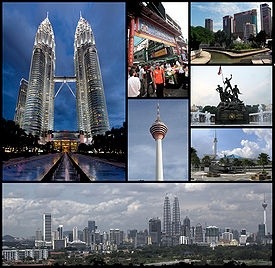
Kuala Lumpur

20120303-105558.jpgFull name: Kuala Lumpur (more commonly known as K.L)
Area: 243.65 km² / 95.18 sq mi
Population: Estimated 1.8 million
National Language: Malay Language (Bahasa Melayu)
Other Spoken Languages: English, Chinese, Tamil
Ethnic Groups: Malay 50.4%, Chinese 23.7%, Indigenous 11%, Indian 7.1%, Others 7.8% (2004 est.)
Religions: Muslim, Buddhist, Taoist, Hindu, Christian, Sikh
Currency: Ringgit Malaysia (RM)
National Anthem: Negaraku
Country code + Area code: +603
Time difference: GMT + 8 (day light savings do not apply)
Weather: tropical; annual southwest (April to October) and northeast (October to February) monsoons
Electricity: 220 volts AC, 50Hz, standard two or three pin British-style plugs
Emergency number: 999 (medical, police and fire)
Places Of Interest: Petronas Twin Towers, Sultan Abdul Samad Building, Kuala Lumpur Railway Station, Menara K.L, Lake Gardens, Dataran Merdeka, National Mosque, National Museum, National Monument, Chinatown, Malaysian Philharmonic Orchestra, National Theatre.
Festivals: Hari Raya, Chinese New Year, Deepavali, Wesak, Federal Territory Day, etc.
Districts: Ampang, Bangsar, Damansara Heights , Cheras, Segambut, Sri Hartamas, etc.
Transportation: Light Rail Transit (LRT), K.L Monorail, Rapid K.L (Bus), KTM Commuter Trains, Taxis

Monday, July 1, 2013

China

China is the most populous nation on earth. With more than 1.2 billion people, it contains one-fifth of the world’s population.
Approximately 93 percent of the people are Han Chinese; the remainder is made up of 350 minority groups — 55 of them are commonly recognized — which have their own language, culture, and religion.
China has the third largest landmass of any nation. Only Russia and Canada are larger. China is slightly larger than the United States.
There are 31 provinces, autonomous regions and special municipalities. Hong Kong, which reverted to China in 1997, is referred to as a special administrative region.
The four largest cities, Chongqing, Shanghai, Beijing, and Tianjin are administered directly by the central government.
Approximately half the land is occupied by minority people groups such as Mongols, Tibetans, Yugur, and Bai. Only about 15 percent of China’s land is farmable, so there is a great strain on the land to feed so many people.
Mandarin Chinese (also known as Putonghua) is the primary language, and is spoken by more than 70 percent of the population. Cantonese prevails in Hong Kong and in parts of the Guangdong Province. Many other dialects abound.
With its first recorded history dating back to 1500 BC, China claims the world’s oldest existing civilization.
During most of its history, China was ruled by a series of dynasties. The last dynasty ended in 1911 with the establishment of a republic by Dr. Sun Yat-sen.
From 1911 until 1949 there was great turmoil in China as various factions fought for supremacy, ending with the establishment of the People’s Republic of China on October 1, 1949.
Since 1949, the country has been under communist rule. China’s governments claims that during that time there has been an eradication of opium, an increased life expectancy, and a reduction of the infant mortality rate.
But, there have also been periods of great turmoil, the worst of which was the Cultural Revolution, officially lasting from 1966-1970, though many historians extend its effects until the death of Mao Ze-dong in 1976.
The Cultural Revolution was a period of unprecedented turmoil in which society was virtually turned upside down.
Students, in the form of Red Guard, went on a rampage. Schools and universities were closed, intellectuals and artists of all kinds were dismissed, persecuted, sent to labor in the countryside, or killed.
Temples, monuments, and works of art were defaced and destroyed. All religious institutions were closed and religious workers were sent to prison or to work in factories or in the countryside. This was a time of suffering for all the Chinese people. Its effects are still felt in society.
Except for a few minority groups and some rural dwellers, families are strongly discouraged from having more than one child.
Those who ignore the admonitions can be severely penalized. The government takes pride in this intrusive manner of population control.
China’s economy has been improving rapidly since 1979 when China opened the doors to foreign investment and opened the economy to more private initiative.
This has resulted in a vast increase of consumer activity, so that upper middle class families have many symbols of middle class affluence: refrigerators, telephones, color televisions, video CD players, and more.
Commercialism and materialism are increasingly popular in China. However, there is still terrible poverty as well.
Even though the Communist government encourages atheism, there are five recognized religions in China today: Buddhism, Taoism, Islam, Catholicism, and Protestant Christianity.
Ancestor worship is a daily practice for many. Confucianism is not officially a religion, though through the centuries, there have periodically been temples devoted to the worship of Confucius.
In any case, Confucianism remains a major element of the Chinese value system. The government cracked down on a very popular Falunggung religious practice in 1999, terming it a dangerous cult.
Robert Morrison was the first Protestant to introduce Christianity in China. He arrived in Canton in 1807.
From that time until 1949, hundreds of sending agencies sent thousands of missionaries to serve in China. China was a difficult mission field; converts came slowly. In 1949 there were no more than 750,000 Protestant Christians in China.
After all the foreign missionaries left China in the early 1950s and all religious institutions were closed from about 1966 because of the Cultural Revolution, it was feared that Christianity might have died out once again.
But, when the churches began to open up in 1979 it was discovered, even to the Chinese Christians’ amazement, that there were at least 6 million Christians.
No longer foreign, all Chinese churches are just that: indigenous Chinese churches, and thousands of Chinese, young and old, are turning to Christ every day.
Nobody really knows how many Christians there are in China. Accurate statistics are hard to come by because there is no systematic or standard reporting system and the numbers change rapidly.
Estimates for members of registered (government sanctioned) congregations range up to 15-20 million, with more than 37,000 congregations meeting in church buildings referred to as churches and 25,000 meeting in other locations, referred to as meeting points.
But there are also many millions of believers, perhaps 45-80 million of them, who meet in house churches that are not government approved.
Even by placing the estimate at the high end of 100 million total Christians, one is reminded that there are still more than one billion Chinese who don’t know Christ!
20120306-074002.jpg

Saturday, June 29, 2013

Snakes

There are around 3000 snake species in the world, and about 375 of these are venomous. From enormous ones like the python, which can swallow animals as large as a deer whole, to snakes that are just a few inches long, snakes can be found in all types of habitats.
While some climb trees, others live underground, and still others are found in the waters of lakes and even seas. Given below are some more fascinating facts about snakes.
Snakes are reptiles that have an elongated body that is flexible and limbless. The shape of the body of snakes is dependent on the habitat they live in.
For example, snakes that burrow underground have a tendency of being more compact, whereas the types that live in trees tend to be slender and long equipped with a prehensile tail which they use to grasp branches, while the body of aquatic snakes is generally flattened.
Snakes occur in a large variety of colors, ranging from dull to brilliant hues with striking patterns. Snakes that have dull coloring use it for camouflage, while those that are brightly colored are usually poisonous.
They use their bright colors to warn predators to stay off. Some non-poisonous snakes mimic the patterns and bright colors of poisonous snakes to fool predators.
As for the size, while the anaconda can grow up to 38 feet in length, the brahminy blind snake is just 2 inches long, making it the smallest snake.
Snakes occur practically all over the world, apart from places like Greenland, Iceland, and Antarctica. However, it is in the tropical regions of the world that most snakes are found.
Like all reptiles, snakes are cold-blooded, which means they do not have the ability of generating adequate amounts of heat in order to keep their body temperature at a constant level. Instead, they are dependent on the heat from their surroundings and the sun to control the temperature of their body. This is the reason most snake species are found in the humid and warm climes of tropical regions.
Another interesting fact about snakes is that they need to shed their skin regularly while they grow, a process known as molting. Snakes shed their skin by rubbing their head against something rough and hard, like a piece of wood or a rock.
This causes the skin, which is already stretched, to split open. The snake keeps on rubbing its skin on various rough objects, resulting in the skin peeling off from its head, enabling it to crawl out, turning the skin inside out.
Snakes have the ability of surviving without food for many days at a stretch after having a filling meal. This is because they have a slow rate of metabolism. In fact, the King Cobra, for example, can go for months without food.
Snakes do not have any eyelids; instead, a transparent scale protects their eyes. Also, they are deaf to airborne sounds, and they ‘hear’ by picking up vibrations through their jawbones.
Plus, snakes use their forked tongue to smell. The tongue gathers particles that are airborne which it then passes to the Jacobson’s Organ, a specialized organ located on the roof of the snake’s mouth.
Snakes have the unique ability of swallowing prey three times larger than their mouth. They can do this because the special tendons located in their mouth are highly stretchable and because the two halves of their jaws are not attached to each other rigidly.
Snakes have more than 200 teeth, which they do not use to chew, since they point backwards, but bite and grip their prey securely.
Being extremely shy animals, we are just beginning to learn more interesting facts about snakes. However, many of their species are disappearing completely for various reasons like being wantonly killed due to fear or for their skins, while their habitats are being continuously eroded and destroyed by us.

Friday, June 28, 2013

Footwear

20120307-073400.jpgSandals originated in warm climates where the soles of the feet needed protection but the top of the foot needed to be cool.


4,000 years ago the first shoes were made of a single piece of rawhide that enveloped the foot for both warmth and protection.
In Europe pointed toes on shoes were fashionable from the eleventh to the fifteenth centuries.
In the Middle East heels were added to shoes to lift the foot from the burning sand.
In Europe in the sixteenth and seventeenth centuries heels on shoes were always colored red.
Shoes all over the world were identical until the nineteenth century, when left- and right-footed shoes were first made in Philadelphia.
In Europe it wasn’t until the eighteenth century that women’s shoes were different from men’s.
Six-inch-high heels were worn by the upper classes in seventeenth-century Europe. Two servants, one on either side, were needed to hold up the person wearing the high heels.
Sneakers were first made in America in 1916. They were originally called keds.
Boots were first worn in cold, mountainous regions and hot, sandy deserts where horse-riding communities lived. Heels on boots kept feet secure in the stirrups.
The first lady’s boot was designed for Queen Victoria in 1840.

Thursday, June 27, 2013

Watch

20120308-073617.jpg 
The use of quartz in watches makes use of a long-known type of electricity known as piezoelectricity. Piezoelectricity is the current which flows from or through a piece of quartz when the quartz is put under electrical and/or mechanical pressure (piezo is from the Greek verb meaning “to press”).
The oldest means of determining time is by observing the location of the sun in the sky. When the sun is directly overhead, the time is roughly 12:00 noon.
A slightly later development, and one less subject to an individual’s judgment, is the use of a sundial. During the daylight hours, sunlight falls on a vertical pole placed at the center of a calibrated dial, thus casting a shadow on the dial and providing the reader with a relatively accurate time reading.
The invention of the mechanical clock in the fourteenth century was a major advancement—it provided a more concise and consistent method of measuring time.
The mechanical clock includes a complicated series of wheels, gears, and levers powered by a falling weights and with a pendulum (or later a wound-up spring). These pieces together moved the hand or hands on a dial to show the time.
The addition of chimes or gongs on the hour, half hour, and quarter hour followed soon afterward. By the eighteenth century, smaller clocks for the home were available, and, unlike their predecessors, were closed and sealed in a case.
Developments in metal technology and in miniaturization, the lubrication of small parts, and the use of first, natural sapphires (and then artificial sapphires) at the spots that received the most stress (the jeweled movement) all became integral components of horological science.
Small pocket watches, perhaps two to three inches (five to seven centimeters) in diameter, were available by the end of the nineteenth century. Mechanical wristwatches were an everyday item in the United States by the 1960s. And yet, the central problem faced by watch and clockmakers remained the same: mechanical parts wear down, become inaccurate, and break.
In the years immediately following World War II, interest in atomic physics led to the development of the atomic clock. Radioactive materials emit particles (decayed) at a known, steady rate.
The parts of a mechanical clock that ratcheted to keep the time could be replaced by a device that stimulated the watch movement each time a particle was emitted by the radioactive element. Atomic clocks, incidentally, are still made and sold, and they are found to be consistently accurate.
With the development of the microchip in the 1970s and 1980s, a new type of watch was invented. Wristwatches that mixed microchip technology with quartz crystals became the standard; there are few non-quartz wristwatches made today.
The microchip is utilized to send signals to the dial of the watch on a continual basis. Because it is not a mechanical device with moving parts, it does not wear out.
A quartz watch uses the electricity from a piece of quartz subjected to the electricity from a battery to send a regular, countable series of signals (oscillations) to one or more microchips. (Electrical wall clocks, in contrast, use the regularity of wall current to keep track of time.)
The most accurate quartz watches are those in which the time appears in an electronically controlled digital display, produced via a light-emitting diode (LED) or a liquid crystal display (LCD).
It is possible, of course, to have the microprocessor send its signals to mechanical devices that make hands move on the watch face, creating an analog display.
But because the hands are mechanically operated through a portion of the watch known as a gear train, analogue watches usually are not as accurate as digitals and are subject to wear.
Both types of watches achieve tremendous accuracy, with digital watches commonly being accurate to within three seconds per month.

Wednesday, June 26, 2013

Mango

The mango is known as the ‘king of fruit’ throughout the world.
The Mango is a member of the cashew family of flowering plants; other species include the pistachio tree and poison ivy.
The name ‘mango’ is derived from the Tamil word ‘mangkay’ or ‘man-gay’. When the Portuguese traders settled in Western India they adopted the name as ‘manga’.
Mangos originated in East India, Burma and the Andaman Islands bordering the Bay of Bengal. Persian traders took the mango into the middle east and Africa, from there the Portuguese brought it to Brazil and the West Indies. Mango cultivars arrived in Florida in the 1830′s and in California in the 1880′s.
The Mango tree is a symbol of love.
Mango leaves are used at weddings to ensure the couple bear plenty of children (though it is only the birth of the male child that is celebrated – again by hanging mango leaves outside the house).
Many Southeast Asian kings and nobles had their own mango groves; with private cultivars being sources of great pride and social standing, hence began the custom of sending gifts of the choicest mangoes.
Burning of mango wood, leaves and debris is not advised – toxic fumes can cause serious irritation to eyes and lungs.
Mango leaves are considered toxic and can kill cattle or other grazing livestock.
Mangos are bursting with protective nutrients. The vitamin content depends upon the variety and maturity of the fruit, when the mango is green the amount of vitamin C is higher, as it ripens the amount of beta carotene (vitamin A) increases.
There are over 20 million metric tons of mangos grown throughout the tropical and sub-tropical world. The leading mango producer is India, with very little export as most are consumed within the country. Mexico and China compete for second place, followed by Pakistan and Indonesia. Thailand, Nigeria, Brazil, Philippines and Haiti follow in order.
The fruit of the mango is called a Drupe – consisting of the mesocarp (edible fleshy part) and endocarp (large woody, flattened pit).
The mango is a member of the Anachardiaceae family. Other distant relatives include the cashew, pistachio, Jamaica plum, poison ivy and poison oak.
The over 1,000 known mango cultivars are derived from two strains of mango seed – monoembryonic (single embryo) and polyembryonic (multiple embryo). Monoembryonic hails from the Indian (original) strain of mango, polyembryonic from the Indochinese.
Dermatitis can result from contact with the resinous latex sap that drips from the stem end when mangos are harvested. The mango fruit skin is not considered edible.
Mangiferin – rich in splenocytes, found in the stem bark of the mango tree has purported potent immunomodulatory characteristics – believed to inhibit tumor growth in early and late stages.
Mangoes contain as much vitamin C as an orange.
To choose a Mango gently squeeze the ‘nose’ of the fruit. If there is slight give then the mango is ripe. Color is not the best indicator of ripeness.
A Mango stored at 55 degrees will last for up to two weeks. Do not refrigerate.
Mangoes are some of the best sources of beta carotene; they contain 20 percent more than cantaloupe and 50 percent more than apricots.

Tuesday, June 25, 2013

Thendayuthapani Temple

Name
Other names: Chettiar Hindu Temple
Proper name: Sri Thendayuthapani Temple
Tamil: ஸ்ரீ தண்டாயுதபாணி கோவில்
Location
Country: Singapore
Location: 15 Tank Road
Architecture and culture
Primary deity: Murugan
Architectural styles: Dravidian architecture
History
Date built: 1859
Creator: Nattukkottai Chettiar Community
The Sri Thendayuthapani Temple, better known as the Chettiar Hindu Temple, is one of Singapore Hindu community’s most important monuments. It was built in the year 1859 by Nattukkottai Chettiar community.   This Shaivite temple, dedicated to the six-faced Lord Subramaniam (Lord Muruga), is at its most active during the festival of Thaipusam, where the procession ends here. It is here, during the annual Thaipusam festival, that hundreds of pilgrims, their bodies pierced by hooks, spears and spiked steel structures called Kavadi, end their walk from the Sri Srinivasa Perumal Temple on Serangoon Road.
The act of penance is carried out by devotees in gratitude to Lord Subramanian or Murugan, son of Lord Siva, for granting their prayers of supplication.
The First Consecration Ceremony
As quoted in their website, the slab stones found at Sri Thendayuthapani Temple show that the temple was consecrated on 4.4.1859. That would mean that the building works had started one or two years earlier.
In fact the community bought the land, where the present temple stands, from the estate of Mr Oxley, the first Surgeon General of Singapore. The temple in its original form was of a simple structure.
At the entrance to the temple, two raised platforms similar to that found in Chettiar households in Tamil Nadu were erected. It had an alangara mandapam and an artha mandapam.
The alangara mandapam was used to house the decorated deities on special occasions while the artha mandapam was the centre hall leading to the main sanctum. The main sanctum was of course dedicated to Lord Muruga in the form of Sri Thendayuthapani.
Subsequent Consecrations  
The old temple underwent some renovation and restoration works on two occasions when the consecration ceremonies were held in 1936 and 1955. However, the community felt the need to upgrade the temple with modern facilities so as to keep pace with the development of Singapore.
The Nagarathars decided in the late seventies, to rebuild the temple on the same site. The temple was to be in the centre with a wedding hall and staff quarters flanking its sides. The food courtyard known as the karthigai kattu was replaced by a wedding hall with car parking facilities. The piling work started on 4 Jan 1981 and was completed on 19 Jan 1983.

Monday, June 24, 2013

Facts About Rain

1. The umbrella was originally invented to protect people from the hot sun.
2. Rain drops can fall at speeds of about 22 miles an hour.
3. Rain starts off as ice or snow crystals at cloud level.
4. Light rain is classified as being no more then 0.10 inchese of rain an hour.
5. Heavy rain is classified as being more then 0.30 inches of rain an hour.
6. Louisiana is the wettest state in the U.S, which receoved an annual rainfall of 56 inches.
7. Rain drops range in size from 0.02 inches to about .031 inches.
8. Rain drops do not fall in a tear drop shape, they originally fall in the shave of a flat oval.
9. Rain that freezes before it hits the ground is known as frozen rain.
10. Rain is recycled water that evaporated from our worlds lakes, rivers, oceans, seas etc.

Saturday, June 22, 2013

Ice Skates

The oldest pair of skates known date back to about 3000 B.C., found at the bottom of a lake inSwitzerland. The skates were made from the leg bones of large animals, holes were bored at each end of the bone and leather straps were used to tie the skates on. An old Dutch word for skate is “schenkel” which means “leg bone”.
Around the 14th Century, the Dutch started using wooden platform skates with flat iron bottom runners. The skates were attached to the skater’s shoes with leather straps.
Poles were used to propel the skater. Around 1500, the Dutch added a narrow metal double edged blade, making the poles a thing of the past, as the skater could now push and glide with his feet (called the “Dutch Roll”).
In 1848, E. V. Bushnell ofPhiladelphia, PA invented the first all steel clamp for skates.
In 1865, Jackson Haines, a famous American skater, developed the two plate all metal blade. The blade was attached directly to Haines’ boots.
The skater became famous for his new dance moves, jumps and spins. Haines added the first toe pick to skates in the 1870′s, making toe pick jumps possible.
The first artificial ice rink (mechanically-refrigerated) was built in 1876, atChelsea, London,England and was named the Glaciarium. It was built near the King’s Road inLondon by John Gamgee.
In 1914, John E. Strauss, a blade maker fromSt. Paul, Minnesota, invented the first closed toe blade made from one piece of steel, making skates lighter and stronger.
The largest outdoor ice rink is the Fujikyu Highland Promenade Rink inJapan, built in 1967 and boasts an ice area of 165,750 square feet– equal to 3.8 acres.

Thursday, June 20, 2013

Teddy Bear

Theodore (Teddy) Roosevelt, the 26th president of the United States, is the person responsible for giving the teddy bear his name. On November 14, 1902, Roosevelt was helping settle a border dispute between Mississippi and Louisiana.
During his spare time he attended a bear hunt in Mississippi. During the hunt, Roosevelt came upon a wounded young bear and ordered the mercy killing of the animal.
The Washington Post ran a editorial cartoon created by the political cartoonist Clifford K. Berryman that illustrated the event.
The cartoon was called “Drawing the Line in Mississippi” and depicted both state line dispute and the bear hunt.   At first Berryman drew the bear as a fierce animal, the bear had just killed a hunting dog.
Later, Berryman redrew the bear to make it a cuddly cub. The cartoon and the story it told became popular and within a year, the cartoon bear became a toy for children called the teddy bear.
Who made the first toy bear called teddy bear?  
Well there are several stories, below is the most popular one:   Morris Michtom made the first official toy bear called the teddy bear.
Michtom owned a small novelty and candy store in Brooklyn, New York. His wife Rose was making toy bears for sale in their store.
Michtom sent Roosevelt a bear and asked permission to use the teddy bear name. Roosevelt said yes. Michtom and a company called Butler Brothers, began to mass-produce the teddy bear. Within a year Michtom started his own company called the Ideal Novelty and Toy Company.
Related Posts Plugin for WordPress, Blogger...