Wednesday, January 2, 2013

Kutraalam

Kutraalam is a panchayat town situated at a mean elevation of 160 m, on the Western Ghats in Tirunelveli District of Tamil Nadu, India. Many seasonal and a few perennial rivers such as the Chittar River, the Manimuthar River, the Pachaiyar River and the Tambaraparani River originate in this region. The numerous waterfalls and cascades along with the ubiquitous health resorts in the area have earned it the title the Spa of South India.
Location
Nestled in the Western Ghats, Kutraalam has exquisite surroundings. The charming hillocks which dominate the scenery disappear into the blue mist of Agasthiarmalai, the mountain bearing the name of a sage who made immense contributions to Tamil literature and is believed to have lived in the area.
The closest towns to Kutraalam are Sengottai and Tenkasi at 5 km and Panpoli at 9 km away. The closest airport is Tuticorin Airport approximately 86 km away and the nearest railway station is Tenkasi, 5 km away.
Falls in Kutraalam
Kutraalam has nine waterfalls.
Peraruvi (main falls) the biggest, is about 60m high. The water, interrupted by the Pongumakadal, a 19m deep crater, comes down with greatly reduced impact, making a bath there safe.
In Chitraruvi (small falls), the flow is thin. Here nature has provided separate places for men and women to bathe. Chitraruvi leads to other waterfalls such as Shenbagadevi and Thenaruvi and the herbal farm.
At Shenbagadevi falls, the water flows through shenbaga (Michaelia champak) trees. There is also a temple there, dedicated to Shenbagadevi Amman.
About 3km from this is Thenaruvi (honey falls), 40m high and cascading between two large stones. In places where there is no water, one sees big honeycombs.
Aintharuvi (five falls) is one where one thoroughly enjoys being in a crowd of bathers. Five separate cascades of water form this waterfalls.
From the orchard above flows Pazhathotta Aruvi, the ‘VIP falls’.
The Pazhaya Courtalla Aruvi (Old Kutraalam falls) used to fall into a valley from between two rocks. The valley was closed and the rocks were broken to change the course of water and make bathing easier. It was reopened later.
The artificial Puli Aruvi (Tiger Falls) has a moderate flow of water which collects in a lake and is diverted for irrigation.
The three major waterfalls reachable by road are the Main Falls, Five Falls, and Old Kutraalam Falls. Other waterfalls like Shenbaga Devi Falls and Honey Falls are reachable only by trekking on the mountain. The smaller falls called the Tiger Falls, called by that name as it was known to have been frequented by tigers looking for water. There is another small falls inside the Government Horticulture Park above Five Falls, but it is off limits to the public. Other attractions include the boat houses near Five Falls and Old Kutraalam Falls, snake park, a public aquarium, small children’s parks and play areas.

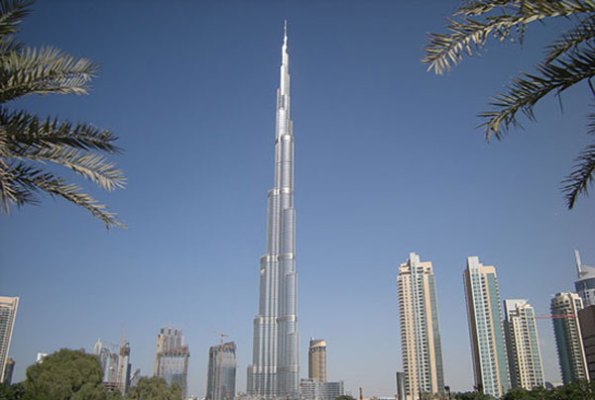
Burj Khalifa

Basic facts
1. Burj Khalifa is located in Dubai, United Arab Emirates (UAE).
2. It’s 828 metres tall (2,717 feet).
3. The exact height was not revealed until final stages of the construction.
4. It was officially opened on Jan 4, 2010.
5. It was previously known as Burj Dubai.
6. Burj means Tower in Arabic language.
7. It’s renamed after Sheikh Khalifa bin Zayed Al Nahyan, the President of UAE and ruler of Abu Dhabi.
World records
8. Tallest building – previously Taiwan’s Taipei 101 (509m).
9. Tallest free-standing structure – previously Canada’s CN Tower (555m).
10. Tallest man-made structure – previously USA’s KVLY-TV Mast (629m).
11. Tallest man-made structure ever – previously Poland’s Warsaw Radio Mast (647m).
12. Building with most floors (160) – previously USA’s World Trade Center (110).
13. Highest elevator installation.
14. Highest outdoor observation deck (~440m)
15. Highest mosque at 158th floor.
16. Fastest elevators at speed of 64km/h, or 18m/s.
17. It would take just a minute to reach from ground level to top floor.

Tortoise

Turtles have been on the earth for more than 200 million years. They evolved before mammals, birds, crocodiles, snakes, and even lizards.
The earliest turtles had teeth and could not retract their heads, but other than this, modern turtles are very similar to their original ancestors.
Turtles live on every continent except Antarctica.
Turtles will live in almost any climate warm enough to allow them to complete their breeding cycle.
While most turtles do not tolerate the cold well, the Blanding’s turtle has been observed swimming under the ice in the Great Lakes region.
Turtles range in size from the 4-inch Bog Turtle to the 1500-pound Leathery Turtle.
North America contains a large variety of turtle species, but Europe contains only two species of turtle and three species of tortoise.
The shell of a turtle is made up of 60 different bones all connected together.
Most land tortoises have high, domed carapaces that offer protection from the snapping jaws of terrestrial predators.
Most turtle species have five toes on each limb with a few exceptions including the American Box Turtle of the Carolina species that only has four toes and, in some cases, only three.
Turtles have good eyesight and an excellent sense of smell. Hearing and sense of touch are both good and even the shell contains nerve endings.
Some aquatic turtles can absorb oxygen through the skin on their neck and cloacal areas allowing them to remain submerged underwater for extended periods of time and enabling them to hibernate underwater.
Turtles are one of the oldest and most primitive groups of reptiles and have outlived many other species. One can only wonder if their unique shell is responsible for their longevity.

Tuesday, January 1, 2013

Kilimanjaro

Elevation: 19,340 feet
Location: Tanzania, east Africa
The meaning and origin of the name Kilimanjaro is unknown. It is thought to be a combination of the Swahili word Kilima, meaning “mountain,” and the KiChagga word Njaro, loosely translated as “whiteness,” giving the name White Mountain.
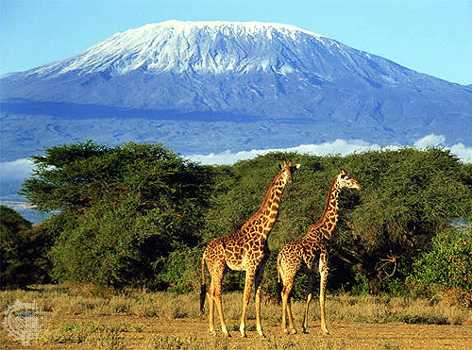
Kilimanjaro, the highest mountain in Africa and fourth highest of the Seven Summits, is considered the tallest freestanding mountain in the world, rising 15,100 feet (4,600 meters) from base to summit.
Kilimanjaro is composed of three distinct volcanic cones: Kibo 19,340 feet (5,895 meters); Mawenzi 16,896 feet (5,149 meters); and Shira 13,000 feet (3,962 meters). Uhuru Peak is the highest summit on Kibo’s crater rim.
Kilimanjaro is a giant stratovolcano that began forming a million years ago when lava spilled from the Rift Valley zone. The mountain was built by successive lava flows. Two of its three peaks—Mawenzi and Shira—are extinct while Kibo, the highest peak is dormant and could erupt again.
Kilimanjaro has 2.2 square kilometers of glacial ice and is losing it quickly due to global warming. The glaciers have shrunk 82% since 1912 and declined 33% since 1989.
Kilimanjaro lies within the 756-square-kilometer Kilimanjaro National Park, a UNESCO World Heritage Site, and is one of the few places on earth that encompasses every ecological life zone including tropical jungle, savannah, and desert to montane forests, subalpine plants, and the alpine zone above timberline.
Kilimanjaro has five common routes to its highest summit: Marangu Route; Machame Route; Rongai Route; Lemosho Route; and Mweka Route.
Climbing Kilimanjaro is easy and requires no technical climbing or mountaineering experience. The biggest challenge and danger is the high altitude. Climbers die from improper acclimatization and altitude sickness rather than falls.
Kilimanjaro is not a peak you can climb on your own. It is mandatory to climb with a licensed guide and have porters carry your equipment. This sustains the local economy and allows local people to reap the rewards of tourism.
The fastest verified ascent time was by Italian Bruno Brunod in 2001. He climbed Uhuru Peak from Marangu Gate in 5 hours, 38 minutes, and 40 seconds. The fastest round-trip time was by local guide Simon Mtuy who ran up and down on December 26, 2004 in 8 hours and 27 minutes.
Mount Meru, a 14,980-foot volcanic cone, lies 45 miles west of Kilimanjaro. It is an active volcano; has a snowcap; lies in Arusha National Park; and is often climbed as a training peak for Kilimanjaro.

Tides

20120228-073621.jpgThe gravitational force of the moon is one ten-millionth that of earth, but when you combine other forces such as the earth’s centrifugal force created by its spin, you get tides.
The sun’s gravitational force on the earth is only 46 percent that of the moon. Making the moon the single most important factor for the creation of tides.
The sun’s gravity also produces tides. But since the forces are smaller, as compared to the
moon, the effects are greatly decreased.
Tides are not caused by the direct pull of the moon’s gravity. The moon is pulling upwards on the water while the earth is pulling downward. Slight advantage to the moon and thus we have tides.
Whenever the Moon, Earth and Sun are aligned, the gravitational pull of the sun adds to that of the moon causing maximum tides.
Spring tides happen when the sun and moon are on the same side of the earth (New Moon) or when the sun and moon are on opposite sides of the earth (Full Moon).
When the Moon is at first quarter or last quarter phase (meaning that it is located at right angles to the Earth-Sun line), the Sun and Moon interfere with each other in producing tidal bulges and tides are generally weaker; these are called neap tides.
Spring tides and neap tide levels are about 20% higher or lower than average.
The surf grows when it approaches a beach, and the tide increases. In bays and estuaries,
this effect is amplified. (In the Bay of Fundy, tides have a range of 44.6 ft.)
The highest tides in the world are at the Bay of Fundy in Nova Scotia, Canada.
Because the earth rotates on its axis the moon completes one orbit in our sky every 25 hours (Not to be confused with moon’s 27 day orbit around the earth), we get two tidal peaks as well as two tidal troughs. These events are separated by about 12 hours.
Since the moon moves around the Earth, it is not always in the same place at the same time each day.
So, each day, the times for high and low tides change by 50 minutes.
The type of gravitational force that causes tides is know as “Tractive” force.

Valcanoes

A volcano is a mountain that opens downward to a pool of molten rock below the surface of the earth. When pressure builds up, eruptions occur.
In an eruption, gases and rock shoot up through the opening and spill over or fill the air with lava fragments. Eruptions can cause lava flows, hot ash flows, mudslides, avalanches, falling ash and floods.
The danger area around a volcano covers about a 20-mile radius.
Fresh volcanic ash, made of pulverized rock, can be harsh, acidic, gritty, glassy and smelly. The ash can cause damage to the lungs of older people, babies and people with respiratory problems.
Volcano eruptions have been known to knock down entire forests.
An erupting volcano can trigger tsunamis, flash floods, earthquakes, mudflows and rockfalls.
More than 80% of the earth’s surface is volcanic in origin. The sea floor and some mountains were formed by countless volcanic eruptions. Gaseous emissions from volcano formed the earth’s atmosphere.
There are more than 500 active volcanoes in the world. More than half of these volcanoes are part of the “Ring of Fire,” a region that encircles the Pacific Ocean.
Active volcanoes in the U.S. are found mainly in Hawaii, Alaska, California, Oregon and Washington, but the greatest chance of eruptions near areas where many people live is in Hawaii and Alaska.
Even though the volcanic eruption in Iceland was relatively small, the ash cloud that was produced disrupted European air travel for six days in April 2010. The eruption created the highest level of air travel disruption World War II.
Crater Lake in Oregon formed from a high volcano that lost its top after a series of tremendous explosions about 6,600 years ago.

Dogs

Dogs have been domesticated for 10,000 years.
There are over 200 different breeds of dogs
Canis Familiaris is the Latin name for dog.
The largest dogs among all breeds, at least in terms of height, is the Irish Wolfhound.
Nearly all but two breeds of dogs have pink tongues. The two exceptions? The Chow Chow and the Shar-pei, both with black tongues.
The Basenji is the only barkless dog in the world.
Dalmatian puppies are born pure white, with their spots developing as the mature.
The ancient Chinese royalty loved the Pekingese, carrying them tucked into the sleeves of their royal robes.
Greyhounds are no doubt fast. In fact, they can reach speeds of up to 45 miles per hour for short amounts of time.
Many dogs’ eyes reflect the color green in the dark, but some also reflect orange or red.
Laikia, a dog, was the world’s first ever space astronaut. She was sent into space in an artificial earth satellite in 1957 by the Russian government.
Survivors of the Titanic included two dogs: a Pekingese belonging to Henry Sleeper Harper and a Pomeranian belonging to Miss Margaret Hays.
The oldest known breed of dog is the Saluki, which is an Arabic word meaning noble one. These dogs were raised as hunting dogs by ancient Egyptians.
The oldest breed of dog native to North America is the Chihuahua.
Every minute, dogs take ten to thirty breaths.
The only mammals with prostates are humans and dogs.
There are 42 teeth in a dog’s mouth.
One of the very first animals domesticated by humans was the dog.
The oldest known dog lived to be 29.
The “spring” in Springer Spaniel referred to this dog’s ability to spring or startle game.
In Flemish, Schipperke translates to “Little Captain.”
The Lhasa Apso was used by monks to guard temples.
Related Posts Plugin for WordPress, Blogger...