Sunday, January 6, 2013

Remote Control

General History
The first machines to be operated by remote control were used mainly for military purposes. Radio-controlled motorboats, developed by the German navy, were used to ram enemy ships in WWI. Radio controlled bombs and other remote control weapons were used in WWII.
Once the wars were over, United States scientists experimented to find nonmilitary uses for the remote control. In the late 1940′s automatic garage door openers were invented, and in the 1950′s the first TV remote controls were used.

History of the TV remote control
Zenith began playing around with the idea of a TV remote control in the early 1950′s. They developed one in 1952 called “Lazy Bones,” which was a long cable that was attached to the TV set. Pushing buttons on the remote activated a motor that would rotate the tuner in the set. This type of remote wasn’t popular for long considering that, at the time, there were very few channels to choose from.
In 1955, the Flash-o-Matic was invented. A flashlight was shined toward light sensitive cells in each of the four corners of the TV. Each corner had a different function. They turned the TV on and off, changed the channel, and controlled the volume. However, people often forgot which corner of the TV operated which control. Also, if the set was in sunlight, the sun’s rays would affect the operations of the TV.
In 1957 a group of engineers developed the Zenith “Space Command,” a wireless remote control using ultrasonic waves. The problem with the ultrasonic control was that clinking metal, such as dog tags, could affect the TV set.
High frequencies sometimes also made dogs bark. The ultrasonic remote was used for two decades until engineers discovered a better way to operate TV’s, the infrared remote control.
On the infrared control, each button has it’s own command, and is sent to the TV set in a series of signals. There is a digital code for each button, and in the TV there is a tiny sensor called a photodetector that identifies the infrared beam, and translates the code into a command.
Manufacturers used to only make remote controls that operated one TV set. However, they’ve recently begun making universal remote controls that can operate any TV set.
Experts predict that someday remote controls will control almost every device in the home.

THE NEXT BEST THIN IS COMING IS GESTURE CONTROL.

Saturday, January 5, 2013

North Pole

North Pole definition

North Pole is situated in the norther hemisphere where the Earth’s axis of rotation meets the Earth’s surface. There is a big difference between Geographic North Pole and Magnetic North Pole.
The Earth’s North Magnetic Pole is the point on the Earth’s surface at which the Earth’s magnetic field points vertically downwards. Magnetic north pole location moves constantly with time. The location of magnetic north pole was defined at 82.7°N 114.4°W in 2005.
James Clark Ross was first who reached the North Magnetic Pole in June 1, 1831. The fact is that the Magnetic North Pole is physically a magnetic field south pole.
North Pole location
The North Pole is located in the middle of the Arctic Ocean which constantly covered with shifting sea ice. The North Pole latitude is 90° North.
At the North Pole all lines of longitude converge there, so North Pole longitude can be defined as any degree value. Greenland is the closest land to geographic north pole (700 km / 440 mi away).
North Pole climate
North Pole weather is much warmer than in South Pole. It is situated in Polar climate zone. The average north pole temperature during winter time is -34°C (-30°F) and average North Pole summer temperature is 0°C (32°F).
The temperature of North Pole changes during last 20 years. Many scientists consider it as a result of global warming. The thickness of ice at the north pole is 3-4 meters.
History of North Pole exploration
The exploration of North Pole has a long history. It is known North Pole fact that the first man who cross Arctic Circle was Greek geographer and explorer Pytheas of Massilia at about 320 BC. So he is considered a first Polar explorer.
The first North Pole map was made by D. Gerasimov, Russian sailor, in the first half of XVI century. But nevertheless the main steps of North Pole discovery were made much later – in the beginning of the last century.
Explorers and enthusiasts tried to achieve North Pole using all possible ways – dog sleds and planes, dirigibles and nuclear icebreakers, skis and parachutes.
It is considered that the first person in the North Pole was Robert Peary. He claimed that he reached the North Pole on April 6, 1909 together with Matthew Henson and four Inuit men. However, it is still controversial north pole fact.
People, who accompanied Peary during the journey, weren’t trained in navigation and couldn’t independently confirm his own navigational results. The other American explorer Frederick Albert Cook stated to have reached the North Pole on April 21, 1908, but he didn’t provide the convincing proof.

Crows

As members of the corvid family, crows are considered to be among the most adaptable and intelligent birds in the world.
Crows are generally black, with black beaks and legs, but they can also be black with white, gray, or brown coloring.
Crows have a varied and evolved language. They can mimic the sounds made by other animals, and they learn to associate noises with events, especially with the distribution of food.
Well-adapted to diverse habitats, crows are found across North America. They thrive in cities and suburban areas where they live in close association with humans.
Crows roost at night in large flocks of up to several thousand during the winter. During the day, smaller groups may fly up to fifty miles in pursuit of food.
Crows are omnivorous. They eat whatever is available to them in their habitat including insects, small amphibians and snakes, earthworms, eggs and nestling birds, and clams, mussels, and other salt-water invertebrates. They also scavenge carrion, garbage, and eat wild and cultivated fruit and vegetables.
With a preference for coniferous trees, crows build their nests in woods or isolated trees at least sixty feet above ground. Nests are solidly built of branches and twigs, and are lined with bark, plant fibers, mosses, twine, and other found materials.
Crows nests are bulky structures built in trees or bushes. They are made of twigs, lined with bark, grasses, and rootlets.
Paired male and female crows share in the incubation of four to six eggs which hatch in eighteen days. Young first fly when they are about one month old. Frequently, at least one young bird will remain with its parents through the next nesting season to assist in the care of new nestlings by bringing them food and guarding the nest.
The female crow lays 4-7 eggs in the nest, and the male helps incubate them. These eggs are greenish or bluish, and blotched with brown. Once hatched, the young remain in the nest 6 – 8 weeks, and in their early life they eat almost half of their weight per day in food, which the parents bring to them.
They are migratory, and will assemble in large flocks in the fall, to travel south.
They eat a number of pests which are harmful to those same crops, including cutworms, wireworms, grasshoppers and even noxious weeds.

Strange Facts – 10

The largest flying animal was the pterosaur which lived 70 million years ago. This reptile had a wing span of 36-39 feet (11-11.9 meters) and weighed 190-250 pounds (86-113.5 kilograms).
The greatest tide change on earth occurs in the Bay of Fundy. The difference between low tide and high tide can be as great as 54 ft. 6 in. (16.6 meters).
The highest temperature produced in a laboratory was 920,000,000 F (511,000,000 C) at the Tokamak Fusion Test Reactor in Princeton, NJ, USA.
The heaviest human brain ever recorded weighed 5 lb. 1.1 oz. (2.3 kg.).
The deepest part of the ocean is 35,813 feet (10,916 meters) deep and occurs in the Mariana Trench in the Pacific Ocean. At that depth the pressure is 18,000 pounds (9172 kilograms) per square inch.
The largest cave in the world (the Sarawak Chamber in Malaysia) is 2,300 feet (701 meters) long, 980 feet (299 meters) wide, and more than 230 feet (70 meters) high.
The hottest planet in the solar system is Venus, with an estimated surface temperature of 864 F (462 C).
The ears of a cricket are located on the front legs, just below the knee.
The first electronic digital computer (called ENIAC – the Electronic Numerical Integrator and Calculator) was developed in 1946 and contained over 18,000 vacuum tubes.
Sound travels about 4 times faster in water than in air.
Boron nitride (BN) is the second hardest substance known to man.
The seeds of an Indian Lotus tree remain viable for 300 to 400 years.
Velcro was invented by a Swiss guy who was inspired by the way burrs attached to clothing.
The microwave was invented after a researcher walked by a radar tube and a chocolate bar melted in his pocket.

Friday, January 4, 2013

Kulfi

Kulfi or Qulfi is a popular frozen dairy dessert from the Indian Subcontinent. It is often described as “traditional Indian Subcontinent ice-cream”.It is popular throughout countries such as India, Pakistan, Bangladesh, Nepal, Burma (Myanmar), and even the Middle East. Kulfi is also widely available in Indian restaurants in Europe, East Asia and North America.
Kulfi has similarities to ice cream in appearance and taste, but is denser and creamier. It comes in various flavours, including cream (malai), raspberry, rose, mango, cardamom, saffron, and pistachio, the more traditional flavours, as well as newer variations like apple, orange, strawberry, peanut, and avocado. Unlike Western ice creams, kulfi is not whipped, resulting in a solid, dense frozen dessert similar to traditional custard based ice-cream.
Thus, it is sometimes considered a distinct category of frozen dairy-based dessert. Due to its density, kulfi takes a longer time to melt than Western ice-cream.
History
Just like any other culture exposed to snow and ice, some people living in the Indian Subcontinent, especially those living high in the Himalayas, would have stumbled upon the technique of freezing various sweetened liquids, thus turning them into frozen desserts. These privileges were limited to the aristocracy until modern day refrigeration technology reached the Subcontinent.
Preparation
Kulfi was traditionally prepared by evaporating sweetened and flavored milk by slow cooking, with almost continuous stirring to keep milk from sticking to the bottom of the vessel where it might burn, until its volume was reduced by a half, thus thickening it, increasing its fat, protein and lactose density.
It has a distinctive taste due to caramelization of lactose and sugar during the lengthy cooking process. The semi-condensed mix is then frozen in tight sealed molds that are then submerged in ice mixed with salt to speed up the freezing process.
The ice/salt mix, along with its submerged kulfi molds, is placed in earthen pots or matkas that provide insulation from the external heat and slow down the melting of ice. Kulfi prepared in this manner is hence called ‘Matka Kulfi’. Kulfi, thus prepared by slow freezing, also renders a unique smooth mouth feel that is devoid of water crystallization.
Traditionally in India, kulfi is sold by vendors called kulfiwallahs who keep the kulfi frozen by placing the moulds inside a large earthenware pot called a “matka”, filled with ice and salt. It is served on a leaf or frozen onto a stick.
It can be garnished with pistachios, cardamom and similar. Often it is served as Falooda Kulfi which is kulfi with rice noodles, rose syrup and other ingredients. Popular flavors include pistachio, mango, vanilla, and rose.

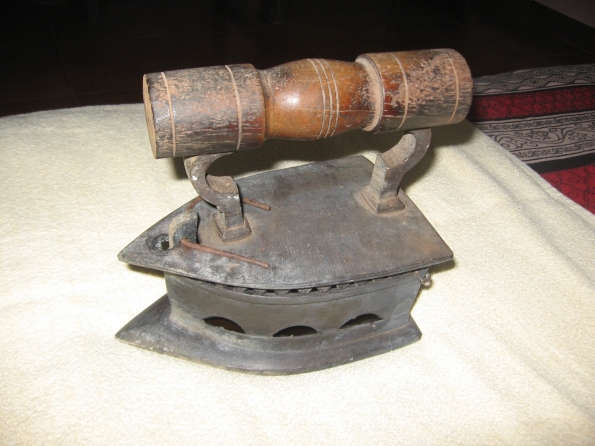
Clothes Iron

A clothes iron, also referred to as simply an iron, is a small appliance used in ironing to remove wrinkles from fabric. Ironing works by loosening the ties between the long chains of molecules that exist in polymer fiber materials.
With the heat and the weight of the ironing plate, the fibers are stretched and the fabric maintains its new shape when cool.
Some materials such as cotton require the use of water to loosen the intermolecular bonds. Many materials developed in the twentieth century are advertised as needing little or no ironing.
The electric iron was invented in 1882 by Henry W. Seeley, a New York inventor. Seeley patented his “electric flatiron” on June 6, 1882 (patent no. 259,054).
History
Metal pans filled with hot water were used for smoothing fabrics in China in the 1st century BC. From the 17th century, sadirons or sad irons began to be used. They were thick slabs of cast iron, delta-shaped and with a handle, heated in a fire. These were also called flat irons.
A later design consisted of an iron box which could be filled with hot coals, which had to be periodically aerated by attaching a bellows. In Kerala in India, burning coconut shells were used instead of charcoal, as they have a similar heating capacity.
This method is still in use as a backup device since power outages are frequent. Other box irons had heated metal inserts instead of hot coals.
Another solution was to employ a cluster of solid irons that were heated from the single source: as the iron currently in use cools down, it could be quickly replaced by another one that is hot.
In the late nineteenth and early twentieth centuries, there were many irons in use which were heated by a fuel such as kerosene, ethanol, whale oil, natural gas, carbide gas as with carbide lamps, or even gasoline.
Some houses were equipped with a system of pipes for distributing natural gas or carbide gas to different rooms in order to operate appliances such as irons, in addition to lights. Despite the risk of fire, liquid-fuel irons were sold in U.S. rural areas up through World War II.
In the industrialized world, these designs have been superseded by the electric iron, which uses resistive heating from an electric current. The hot plate, called the sole plate, is made of aluminium or stainless steel.
The heating element is controlled by a thermostat which switches the current on and off to maintain the selected temperature. The invention of the resistively heated electric iron is credited to Henry W. Seeley of New York in 1882.
In the same year an iron heated by a carbon arc was introduced in France, but was too dangerous to be successful. The early electric irons had no easy way to control their temperature, and the first thermostatically controlled electric iron appeared in the 1920s. Later, steam was used to iron clothing. Credit for the invention of the steam iron goes to Thomas Sears.

Dreams

 
1. You Forget 90% of Your Dreams
Within 5 minutes of waking half of your dream is forgotten. Within 10, 90% is gone.
2. Blind People also Dream
People who became blind after birth can see images in their dreams. People who are born blind do not see any images, but have dreams equally vivid involving their other senses of sound, smell, touch and emotion.
3. Everybody Dreams
Every human being dreams. If you think you are not dreaming – you just forget your dreams.
4. In Our Dreams We Only See Faces That We already Know
Our mind is not inventing faces – in our dreams we see real faces of real people that we have seen during our life but may not know or remember.
5. Not Everybody Dreams in Color
A full 12% of sighted people dream exclusively in black and white. The remaining number dream in full color.
6. Dreams are Symbolic
If you dream about some particular subject it is not often that the dream is about that. Dreams speak in a deeply symbolic language. Whatever symbol your dream picks on it is most unlikely to be a symbol for itself.
7. Emotions
The most common emotion experienced in dreams is anxiety. Negative emotions are more common than positive ones.
8. You can have four to seven dreams in one night.
On average you can dream anywhere from one or two hours every night.
9. Animals Dream Too
Studies have been done on many different animals, and they all show the same brain waves during dreaming sleep as humans. Watch a dog sleeping sometime.
10. Body Paralysis
Rapid eye movement (REM) sleep is a normal stage of sleep characterized by rapid movements of the eyes. REM sleep in adult humans typically occupies 20-25% of total sleep, about 90-120 minutes of a night’s sleep.
11. Dream Incorporation
Our mind interprets the external stimuli that our senses are bombarded with when we are asleep and make them a part of our dreams. This means that sometimes in our dreams we hear a sound from reality and incorporate it in a way.
12. Men and Women Dream Differently
Men tend to dream more about other men. Around 70% of the characters in a man’s dream are other men. On the other hand, a woman’s dream contains almost an equal number of men and women.
13. Precognitive Dreams
Results of several surveys across large population sets indicate that between 18% and 38% of people have experienced at least one precognitive dream and 70% have experienced déjà vu.
14. If you are snoring, then you cannot be dreaming.
This fact is repeated all over the Internet, but I’m a bit suspicious whether it’s really true as I haven’t found any scientific evidence to support it.
Related Posts Plugin for WordPress, Blogger...