Monday, February 4, 2013

Eiffel Tower

An iconic symbol of French culture, liberty, and progress, the Eiffel Tower in Paris was completed for the 1889 World Fair, which happened to coincide with the 100th anneversary of the French Revolution. From the numerous designs submitted as part of a national competition, Alexandre Gustave Eiffel’s design won, and he became responsible for constructing the Eiffel Tower in the heart of Paris.
Eiffel Tower Facts
Start of Eiffel Tower construction: January 26, 1887
Completion of Eiffel Tower construction: March 31, 1889
Construciton Time for the Eiffel Tower: 2 years, 2 months, and 5 days-start to finish
Principal Designer/Contractor: Alexandre Gustave Eiffel
Principal Architect: Stephen Sauvestre
Main Engineers: Maurice Koechlin and Emile Nouguier
Height of the Eiffell Tower: 324 meters tall
Tower Material: 9441 tons of wrought iron (puddle iron)
Number of Tower Components: 18,038 pieces of wrought iron and 2.5 million rivets
Area Covered by the Tower at the Base: 100 Meters
Wieght of the Tower: 10,000 tons, with 7,300 tons being metal.
Approximate Number of Vistors to the Tower Each Year: 6.8 million people
Number of Stories in the Tower: 108

Biotechnology

Biotechnology is a field of applied biology that involves the use of living organisms and bioprocesses in engineering, technology, medicine and other fields requiring bioproducts.
Biotechnology also utilizes these products for manufacturing purpose.
Modern use of similar terms includes genetic engineering as well as cell- and tissue culture technologies.
The concept encompasses a wide range of procedures for modifying living organisms according to human purposes — going back to domestication of animals, cultivation of plants, and “improvements” to these through breeding programs that employ artificial selection and hybridization.
The United Nations Convention on Biological Diversity defines biotechnology as:
Any technological application that uses biological systems, living organisms, or derivatives thereof, to make or modify products or processes for specific use.
In other terms: “Application of scientific and technical advances in life science to develop commercial products” is biotechnology.
Biotechnology draws on the pure biological sciences (genetics, microbiology, animal cell culture, molecular biology, biochemistry, embryology, cell biology) and in many instances is also dependent on knowledge and methods from outside the sphere of biology (chemical engineering, bioprocess engineering, information technology, biorobotics).
Conversely, modern biological sciences are intimately entwined and dependent on the methods developed through biotechnology and what is commonly thought of as the life sciences industry.

Sunday, February 3, 2013

About IRON

Iron is one of the Hardest metals in the Universe, Let us know some more about them in detail which may be very useful for your Improvement of General Knowledge

 1) Iron is the 10th Most abundant element in the Universe

2) Iron is the 4th Most Abundant in the Earth Crust

3) From the Iron ore, The metal called Iron was extracted

4) Iron is almost never found in the Elemental state

5) In the Production of Alloys, Iron plays an Key Role and it is the Major Component of the Steel

6) As a Ferrous ion, iron is the Most necessary trace element used by all the living Organisms

7) Ferrum was the Latin name for the iron, so as The symbol "Fe" has been given for the iron

8) The Meteorites was the source of the iron for the Prehistoric man

9) China is the Worlds Largest Producer of the Iron in the World

10) Iron falls to the Transition Metal Category'

11) Iron i s formed in the Stars that have that have Sufficient mass by the Fusion Process

12) The Sun contains more amounts of iron than the Earth

Saturday, February 2, 2013

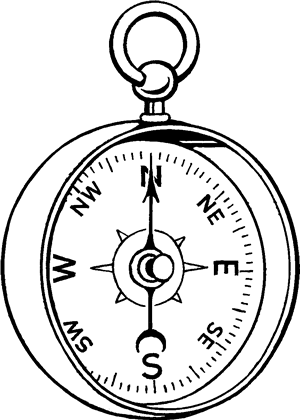
Compass

A compass is an instrument containing a freely suspended magnetic element which displays the direction of the horizontal component of the Earth’s magnetic field at the point of observation.
Magnetic Compass
The magnetic compass is an old Chinese invention, probably first made in China during the Qin dynasty (221-206 B.C.). Chinese fortune tellers used lodestones (a mineral composed of an iron oxide which aligns itself in a north-south direction) to construct their fortune telling boards.
Eventually someone noticed that the lodestones were better at pointing out real directions, leading to the first compasses. They designed the compass on a square slab which had markings for the cardinal points and the constellations. The pointing needle was a lodestone spoon-shaped device, with a handle that would always point south.
Magnetized Needles
Magnetized needles used as direction pointers instead of the spoon-shaped lodestones appeared in the 8th century AD, again in China, and between 850 and 1050 they seem to have become common as navigational devices on ships.
Compass as a Navigational Aid
The first person recorded to have used the compass as a navigational aid was Zheng He (1371-1435), from the Yunnan province in China, who made seven ocean voyages between 1405 and 1433.
Ferrites or magnetic oxides are stones that attract iron and other metals. These are natural magnets and are not inventions. However, the machines that we make with magnets are inventions.
Ferrites were first discovered thousands of year ago. Large deposits were found in the district of Magnesia in Asia Minor, giving the mineral’s name of magnetite (Fe3O4).
Magnetite was nicknamed lodestone and used by early navigators to locate the magnetic North Pole. William Gilbert published De Magnete, a paper on magnetism in 1600, about the use and properties of Magnetite. In 1819, Hans Christian Oersted reported that when an electric current in a wire was applied to a magnetic compass needle, the magnet was affected – this is called electromagnetism.
In 1825, British inventor William Sturgeon (1783-1850) exhibited a device that laid the foundations for large-scale electronic communications: the electromagnet. Sturgeon displayed its power by lifting nine pounds with a seven-ounce piece of iron wrapped with wires through which the current of a single cell battery was sent.
Cow Magnets
U.S. patent # 3,005,458 is the first patent issued for a cow magnet issued to Louis Paul Longo, the inventor of the Magnetrol Magnet, for prevention of hardware disease in cows

Strange Facts

It takes 17 muscles to smile & 43 to frown
OSTRICH eats pebbles to help digestion by grinding up the ingested food
When you sneeze air rushes out your nose at a rate of 100 miles per hour
The cosmos contains approximately 50,000,000,000 galaxies
Owl is the only bird, which can rotate its head to 270 degrees
Buddha delivered his first sermon at Sarnath
Hummingbirds are the only animal that can also fly backwards
A 15 letter word that can be spelled without repeating a letter is uncopyrightable
8.7 million of United State residents who were born in Asia.
KIWIS are the only birds, which hunt by sense of smell
Dolphins sleep with one eye open
Bats always turn left when exiting a cave
Cat’s urine glows under a black light
Bird Feeding: Do not feed avocado as it is toxic to birds
Vitamin K is necessary for clotting of blood
A Blue Whale can eat as much as 3 tones of food everyday, but at the same time can live without food for 6 months

Friday, February 1, 2013

Jupiter – The Planet

Jupiter is the fifth planet from the Sun and is the largest planet in the solar system. If Jupiter were hollow, more than one thousand Earths could fit inside. It also contains two and a half times the mass of all the other planets combined.
It has a mass of 1.9 x 1027 kg and is 142,800 kilometers  across the equator. Jupiter possesses 62 known satellites. The four largest are Callisto, Europa, Ganymede and Io, and were named after Galileo Galilei who observed them as long ago as 1610. The German astronomer Simon Marius claimed to have seen the moons around the same time, but he did not publish his observations and so Galileo is given the credit for their discovery.
Jupiter has a very faint ring system, but is totally invisible from the Earth.  The atmosphere is very deep, perhaps comprising the whole planet, and is somewhat like the Sun. It is composed mainly of hydrogen and helium, with small amounts of methane, ammonia, water vapor and other compounds. At great depths within Jupiter, the pressure is so great that the hydrogen atoms are broken up and the electrons are freed so that the resulting atoms consist of bare protons. This produces a state in which the hydrogen becomes metallic.
Auroral emissions, similar to Earth’s northern lights, were observed in the polar regions of Jupiter. The auroral emissions appear to be related to material from Io that spirals along magnetic field lines to fall into Jupiter’s atmosphere. Cloud-top lightning bolts, similar to superbolts in Earth’s high atmosphere, were also observed.
Jupiter Statistics
Mass (kg) : 1.900e+27
Equatorial radius (km) : 71,492
Mean distance from the Sun (km) : 778,330,000
Rotational period (days) : 0.41354
Orbital period (days) : 4332.71
Tilt of axis (degrees) : 3.13
Orbital inclination (degrees) : 1.308
Magnitude (Vo) -2.70
Mean cloud temperature : -121°C
Atmospheric pressure (bars) : 0.7
Atmospheric composition:
Hydrogen : 90%
Helium : 10%

Veenai

Veenai is a popular Carnatic music instrument that is said to be many centuries old. Western music scholars believe that the instrument has many characteristics that belong to European style lute. The Veenai has many discrepancies in sound and shape it has been customized and improvised over the decades to create a unique style from the lute.
This 1.5 meter long instrument has two drones on both the side to give it an even balance and is connected with four different strings along with frets that give different harmonics than any other music device. Veenai being an age old musical instrument holds religious importance and also symbolizes ancient culture and heritage in southern India.
History of Instrument
The history of Veenai dates back to the Vedic period which is about 1500BCE. The legend states that it all began when a hunter first discovered a different sound from his bow when it began to vibrate. The curious hunter tried various grass roots and animal fiber to create music, which in turn gave birth to the formation of Veena.
Once the basic structure of the Veenai was formed, further changes took place to bring about a distinctive sound. In the olden days this instrument had very few frets but today the Sarswathi Veenai is said to have 24 frets on it. Besides this, the instrument also has religious association, as it has been described in many sacred texts that as goddess Sarawati playing this instrument. She is also represented as the Goddess of Knowledge.

Types
- Saraswati Veena
- Rudra Veena
- Vichitra Veena
Kolkata craftsmen have been well known for creating the best Saraswati Veenai and Thanjavur artisans are famous for producing some of the finest Rudra Veenai and Vichitra Veenai in the world.
There are many modern day versions to it such as Ranjan Veenai and Mohan Veena. While the former looks similar to the sitar, the latter has a close resemblance to the guitar.

Famous Veenai Players
Veenai Ranganayaki Rajagopalan, Veenai Dhanammal, Rugmini Gopalakrishnan, Doraiswamy Iyengar, Veene Sheshanna, Veenai Venkatagiriappa, Emani Sankara Sastry, Chitti Babu, Rajhesh Vaidhya and so on.
Related Posts Plugin for WordPress, Blogger...