Sunday, May 19, 2013

Avocado


Avocados are a fruit, not a vegetable.
There are more than 500 avocado varieties.
Avocados are native to Central and South America, where they have been cultivated for over 10,000 years.
Another name for the avocado is the “alligator pear,” so-called because of its alligator skin texture and pear shape.
Spanish explorers could not pronounce ahuacatl, so they called the avocado aguacate. This is the origin of the word guacamole.
The origin of guacamole is the Aztec avocado sauce called ahuaca-hulli.
The Hass is the most common avocado in the United States and is the only avocado grown year round.
The average avocado contains 300 calories and 30 grams of healthy polyunsaturated and monounsaturated fat.
Avocados have the highest protein content of any fruit.
Avocados contain more potassium than bananas.
One avocado contains 81 mcg of lutein, an important nutrient for healthy eyes.
Once an avocado is picked, it takes between 7 and 10 days to ripen. Keeping it in the refrigerator will slow down the ripening process, while putting it in a paper bag with a ripe apple will speed up the process.

Saturday, May 18, 2013

Bicycle Facts

In 1817, Karl von Drais, a German baron, invented a horseless carriage that would help him get around faster. The two-wheeled, pedal-less device was propelled by pushing your feet against the ground, The machine became known as the “draisine,” and led to the creation of the modern-day bicycle.
The term “bicycle” was not introduced until the 1860s, when it was coined in France to describe a new kind of two-wheeler with a mechanical drive.
Orville and Wilbur Wright, the brothers who built the first flying airplane, operated a small bike repair shop in Dayton, Ohio. They used their workshop to build the 1903 Wright Flyer.
Fred A. Birchmore, 25, circled the globe by bicycle in 1935. The entire trip, through Europe, Asia, and the United States, covered forty thousand miles. He pedaled about 25,000 miles. The rest was traveled by boat. He wore out seven sets of tires.
There are over a half billion bicycles in China. Bikes were first brought to China in the late 1800s.
About 100 million bicycles are manufactured worldwide each year.
Over the past 30 years, bicycle delivery services have developed into an important industry, especially in cities, where the couriers have earned a reputation for their high speed and traffic-weaving skills.
Americans use their bicycles for less than one percent of all urban trips. Europeans bike in cities a lot more often—in Italy 5 percent of all trips are on bicycle, 30 percent in the Netherlands, and seven out of eight Dutch people over age 15 have a bike.
The Tour de France is one of the most famous bicycle races in the world. Established in 1903, it is considered to be the biggest test of endurance out of all sports. Lance Armstrong, an American cyclist, is the only rider to have won seven titles (1999–2005) after surviving cancer.
Bicycle Moto Cross (BMX), an extreme style of bicycle track racing, became a sport in the 2008 Summer Olympic Games in Beijing, China. Maris Strombergs, of Latvia, received the gold medal for Men’s BMX, and Anne-Caroline Chausson, from France, took home the gold in the first Women’s BMX Olympic event.

Wednesday, May 15, 2013

BEER

Beer is the world’s most widely consumed alcoholic beverage; it is the third-most popular drink overall, after water and tea. It is thought by some to be the oldest fermented beverage.
Beer is produced by the saccharification of starch and fermentation of the resulting sugar. The starch and saccharification enzymes are often derived from malted cereal grains, most commonly malted barley and malted wheat.
Unmalted maize and rice are widely used adjuncts to lighten the flavor because of their lower cost. The preparation of beer is called brewing.
Most beer is flavoured with hops, which add bitterness and act as a natural preservative, though other flavourings such as herbs or fruit may occasionally be included.
Some of humanity’s earliest known writings refer to the production and distribution of beer: the Code of Hammurabi included laws regulating beer and beer parlours, and “The Hymn to Ninkasi”, a prayer to the Mesopotamian goddess of beer, served as both a prayer and as a method of remembering the recipe for beer in a culture with few literate people.
Today, the brewing industry is a global business, consisting of several dominant multinational companies and many thousands of smaller producers ranging from brewpubs to regional breweries.
The strength of beer is usually around 4% to 6% alcohol by volume (abv) although it may sometimes vary between 0.5% (de-alcoholized) and 15% (malt liquors).
Beer forms part of the culture of beer-drinking nations and is associated with social traditions such as beer festivals, as well as a rich pub culture involving activities like pub crawling and pub games such as bar billiards.

Tuesday, May 14, 2013

London Bridge

Carries: 5 lanes of A3
Crosses: River Thames
Locale: Inner London
Maintained by: Bridge House Estates, City of London Corporation
Design: prestressed concrete box girder bridge
Total length: 269 m (882.5 ft)
Width: 32 m (105.0 ft)
Opened: 17 March 1973
London Bridge is a bridge over the River Thames, connecting the City of London and Southwark, in central London.
Situated between Cannon Street Railway Bridge and Tower Bridge, it forms the western end of the Pool of London.
On the south side of the bridge are Southwark Cathedral and London Bridge station; on the north side are the Monument to the Great Fire of London and Monument tube station.
It was the only bridge over the Thames downstream from Kingston until Putney Bridge opened in 1729. The current bridge opened on 17 March 1973 and is the latest in a succession of bridges to occupy the spot and claim the name.
The bridge carries part of the A3 road, which is maintained by the Greater London Authority; the bridge itself is owned and maintained by the Bridge House Estates, an independent charity overseen by the City of London Corporation.
The area between London Bridge and Tower Bridge on the south side of the Thames is a business improvement district (BID) and is managed by Team London Bridge.

Monday, May 13, 2013

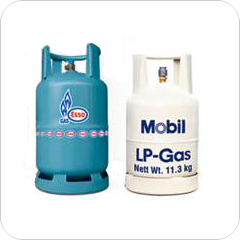
LPG

Liquefied petroleum gas, also called LPG, GPL, LP Gas, liquid petroleum gas or simply propane, is a flammable mixture of hydrocarbon gases used as a fuel in heating appliances and vehicles.
It is increasingly used as an aerosol propellant and a refrigerant, replacing chlorofluorocarbons in an effort to reduce damage to the ozone layer.
When specifically used as a vehicle fuel it is often referred to as autogas.   Varieties of LPG bought and sold include mixes that are primarily propane (C3H8), primarily butane (C4H10) and, most commonly, mixes including both propane and butane, depending on the season — in winter more propane, in summer more butane.
In the United States, primarily only two grades of LPG are sold, commercial propane and HD-5. These specifications are published by the Gas Processors Association (GPA) and the American Society of Testing and Materials (ASTM).
Propane/butane blends are also listed in these specifications. Propylene, butylenes and various other hydrocarbons are usually also present in small concentrations. HD-5 limits the amount of propylene that can be placed in LPG, and is utilized as an autogas specification.
A powerful odorant, ethanethiol, is added so that leaks can be detected easily. The international standard is EN 589. In the United States, tetrahydrothiophene (thiophane) or amyl mercaptan are also approved odorants, although neither is currently being utilized.
LPG is synthesised by refining petroleum or “wet” natural gas, and is almost entirely derived from fossil fuel sources, being manufactured during the refining of petroleum (crude oil), or extracted from petroleum or natural gas streams as they emerge from the ground.
It was first produced in 1910 by Dr. Walter Snelling, and the first commercial products appeared in 1912. It currently provides about 3% of all energy consumed, and burns relatively cleanly with no soot and very few sulfur emissions. As it is a gas, it does not pose ground or water pollution hazards, but it can cause air pollution.
LPG has a typical specific calorific value of 46.1 MJ/kg compared with 42.5 MJ/kg for fuel oil and 43.5 MJ/kg for premium grade petrol (gasoline). However, its energy density per volume unit of 26 MJ/l is lower than either that of petrol or fuel oil.
LPG evaporates quickly at normal temperatures and pressures and is usually supplied in pressurised steel gas cylinders. They are typically filled to between 80% and 85% of their capacity to allow for thermal expansion of the contained liquid.
The ratio between the volumes of the vaporized gas and the liquefied gas varies depending on composition, pressure, and temperature, but is typically around 250:1.

Saturday, May 11, 2013

ENGLISH

English is a West Germanic language spoken originally in England, and is now the most widely used language in the world. It is spoken as a first language by a majority of the inhabitants of several nations, including the United Kingdom, the United States, Canada, Australia, Ireland and New Zealand.
It is the third most common native language in the world, after Mandarin Chinese and Spanish. It is widely learned as a second language and is an official language of the European Union, many Commonwealth countries and the United Nations, as well as in many world organisations.
English arose in the Anglo-Saxon kingdoms of England and what is now south-east Scotland, but was then under the control of the kingdom of Northumbria.
Following the extensive influence of Great Britain and the United Kingdom from the 18th century, via the British Empire, and of the United States since the mid-20th century, it has been widely propagated around the world, becoming the leading language of international discourse and the lingua franca in many regions.
Historically, English originated from the fusion of closely related dialects, now collectively termed Old English, which were brought to the eastern coast of Great Britain by Germanic (Anglo-Saxon) settlers by the 5th century – with the word English being derived from the name of the Angles, and ultimately from their ancestral region of Angeln.
A significant number of English words are constructed based on roots from Latin, because Latin in some form was the lingua franca of the Christian Church and of European intellectual life. The language was further influenced by the Old Norse language due to Viking invasions in the 8th and 9th centuries.
The Norman conquest of England in the 11th century gave rise to heavy borrowings from Norman-French, and vocabulary and spelling conventions began to give the appearance of a close relationship with Romance languages to what had then become Middle English.
The Great Vowel Shift that began in the south of England in the 15th century is one of the historical events that mark the emergence of Modern English from Middle English.
Owing to the assimilation of words from many other languages throughout history, modern English contains a very large vocabulary, with complex and irregular spelling, particularly of vowels.
Modern English has not only assimilated words from other European languages but also from all over the world, including words of Hindi and African origin.
The Oxford English Dictionary lists over 250,000 distinct words, not including many technical, scientific, and slang terms.

Friday, May 10, 2013

Designer of Your Future

Fracas
Definition: (noun)
Noisy quarrel.
Synonyms: affray, altercation.

Who Is Credited With The Discovery Of Artificial Cell ?
Craig Venter

Viagra Chemical Name: Sildenafil Citrate

1 Bbarrel=159Litre

The Global Positioning System (GPS) is a space-based satellite navigation system that provides location and time information in all weather.

BY TARUN PATEL (WWW.APPS4ALLMOBI.COM)
If you Translate Every Mistake of Your Life into a 'Positive' One,
YOU will Never be a 'Prisoner of Your Past'
but a 'Designer of Your Future'

Large-minded
Definition: (adjective)
Marked by breadth or tolerance of views; broad-minded.
Synonyms: liberal, tolerant.
Related Posts Plugin for WordPress, Blogger...